This is one of the oldest continuously inhabited wetlands on Earth. The Mesopotamian Marshes sit where the Tigris and Euphrates converge in southern Iraq — a vast maze of reed-lined waterways, floating islands, and shallow lakes that stretches across thousands of square kilometres. The Marsh Arabs have lived here for over 5,000 years. Their reed houses look the same as carvings found in Sumerian temples. The water buffalo still wade through the channels at dawn. And almost no tourists come here.
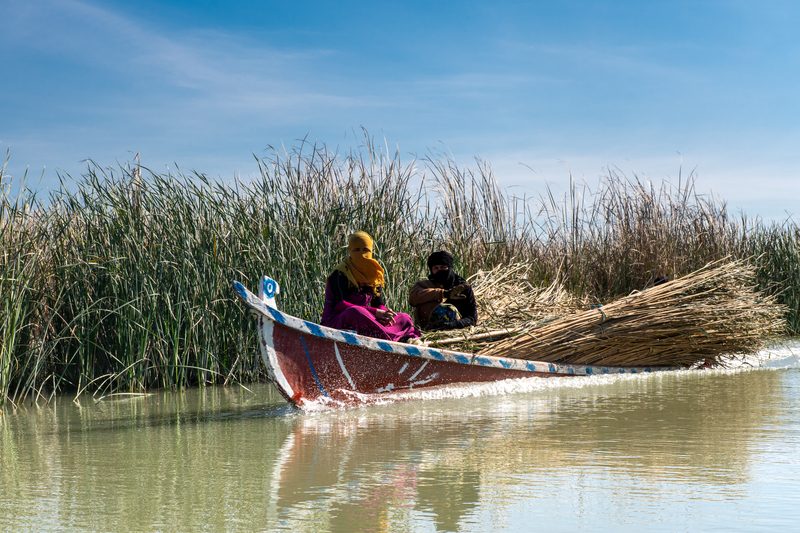
That’s what makes the marshes special. This isn’t a destination that’s been polished for visitors. It’s a living culture in a landscape that some scholars believe inspired the biblical Garden of Eden. UNESCO recognised it as a World Heritage Site in 2016, and I consider it the single most unforgettable experience I offer. If you’re still planning the broader trip, my Iraq travel guide covers everything from visas to itineraries.
What Are the Mesopotamian Marshes?
The marshes — known locally as the Ahwar — are a network of wetlands in southern Iraq formed by the floodplains of the Tigris and Euphrates rivers. They once covered roughly 15,000–20,000 square kilometres (depending on the season), making them the largest wetland ecosystem in the Middle East. Three main areas make up the system: the Central Marshes between the two rivers, the Hammar Marshes south of the Euphrates, and the Hawizeh Marshes to the east near the Iranian border.
The people who live here are the Ma’dan — the Marsh Arabs. For millennia they’ve built their lives around the water: harvesting reeds, herding water buffalo, fishing, and constructing extraordinary buildings entirely from gathered reeds. Their culture is directly descended from the Sumerians who lived in the same marshes and built the first cities on Earth just a few kilometres away at Ur and Uruk.
Then Saddam tried to destroy it. In the 1990s, after Shia communities in the south rose up against his regime, Saddam Hussein ordered the marshes drained as collective punishment. Dykes, canals, and diversion structures reduced the wetlands to roughly 10% of their original size. Entire communities were displaced. A way of life that had survived for five thousand years nearly ended in a decade.
After 2003, locals began dismantling the dams and water flowed back. The marshes have partially recovered — currently around 40% of their original extent — and in 2016 UNESCO inscribed the Ahwar of Southern Iraq as a World Heritage Site, recognising both the wetlands and the nearby ancient cities of Ur, Uruk, and Eridu. It was Iraq’s first such dual natural-cultural designation.
The marshes still face threats. Upstream dams in Turkey and Iran reduce river flow, and climate change is making the region hotter and drier. Some Marsh Arab families have had to sell their buffalo herds or leave. Visiting the marshes — and spending money in the local economy — is one small way the outside world can help this place survive.
What You’ll See and Do
Boat Tour Through the Marshes
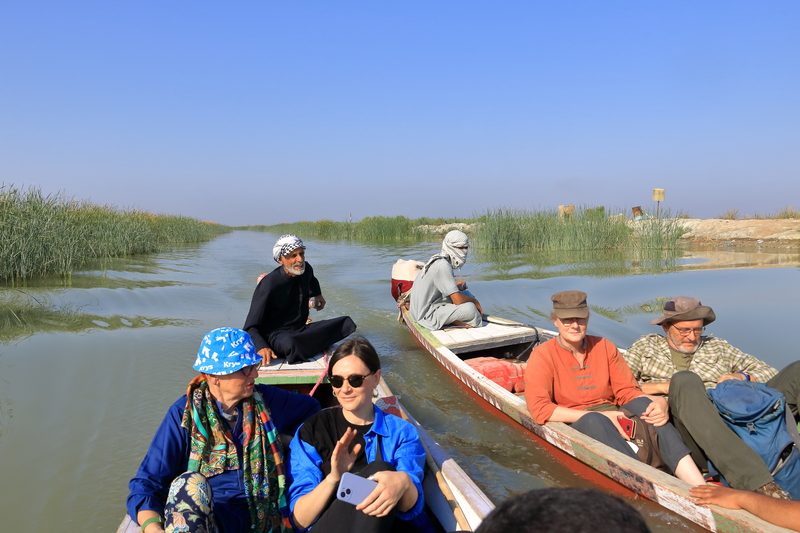
The centrepiece of any visit is a boat trip through the waterways in a mashoof — the traditional slender canoe that Marsh Arabs have used for centuries. Your boatman poles and paddles through narrow channels between towering reeds, opening out into wide lagoons and back into intimate passages where the reeds close overhead.
A typical tour lasts 2–4 hours. You’ll see water buffalo cooling in the shallows (and often blocking the way), herons and egrets lifting off the water, kingfishers darting between the reeds, and — if you’re here in migration season — species travelling between Siberia and Africa. The endangered Basra reed warbler, which breeds primarily in these marshes, is one of the rarest birds in the Middle East. Bring a camera with good zoom.
The silence is the thing people remember most. No engines. No roads. Just water, reeds, and the occasional splash of a fish. It’s unlike anywhere else I’ve taken guests.
Visit a Reed House (Mudhif)
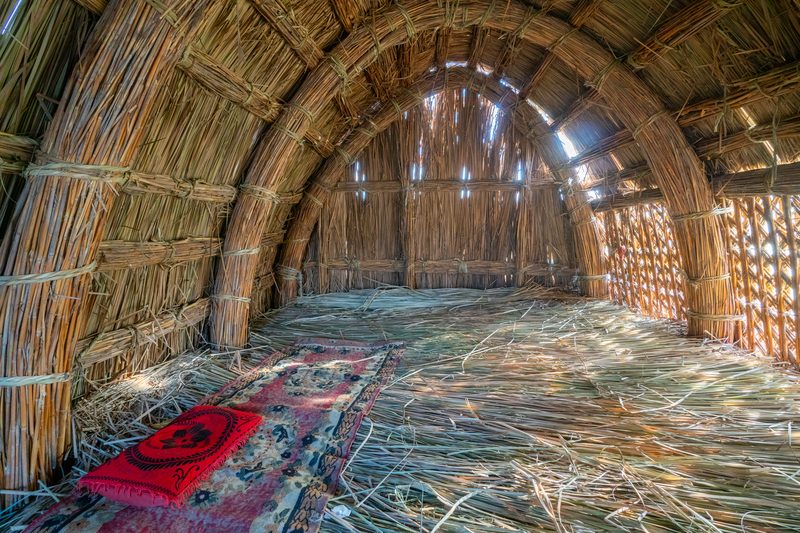
The mudhif is a traditional Marsh Arab guest house built entirely from reeds — no nails, no wood, no concrete. The arched construction looks exactly like structures depicted in Sumerian carvings from 3000 BC. These buildings are social hubs: community meeting places, guest halls, and the centre of village life.
Visiting a mudhif means sitting on woven reed mats, drinking sweet tea with local families, and getting a firsthand look at architecture that has genuinely not changed in five millennia. The families are generous and curious — they don’t get many foreign visitors, and most are happy to show you how they weave reeds, make bread, and tend their buffalo.
Masgouf Lunch on the Water
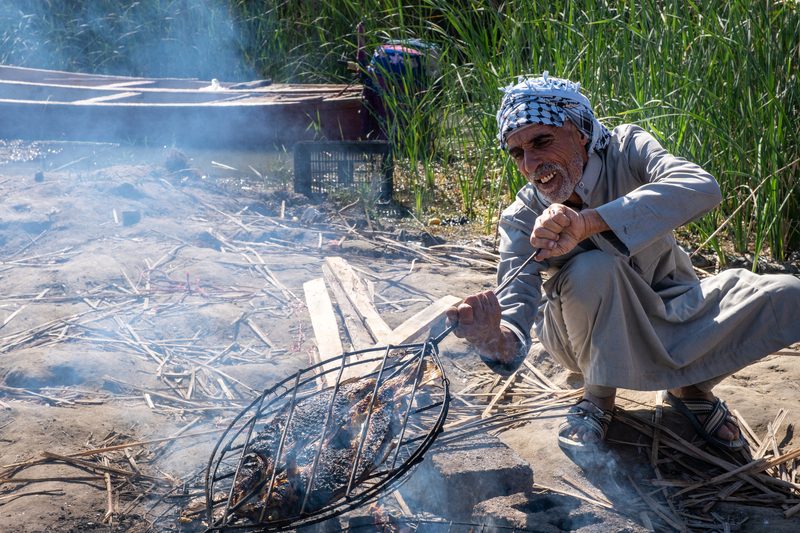
I arrange lunch with local families in the marshes — usually masgouf, Iraq’s national dish of carp grilled slowly over an open fire. Eating fresh-caught fish beside the water where it was swimming an hour earlier, served on a reed mat in a mudhif, is one of those meals you don’t forget. It’s simple food in an extraordinary setting.
Overnight in the Marshes
For guests who want the full experience, spending a night in the marshes is something I strongly recommend. You sleep in a reed house, watch the sunset paint the water orange, and wake up to the sound of buffalo and birds at dawn. The facilities are basic — don’t expect electricity or running water — but that’s the point. There are very few places left on Earth where you can experience a way of life this ancient and this untouched.
The overnight isn’t for everyone, and I never pressure guests into it. But those who do it consistently tell me it was the highlight of their entire Iraq trip.
Practical Information
How to Get There
The gateway to the marshes is the town of Chibayish in Thi Qar Province. From Baghdad, it’s roughly a 5–6 hour drive south (including checkpoints). From Najaf (a common stop on southern Iraq itineraries), it’s about 4–5 hours via Nasiriyah.
The marshes are not a day trip from Baghdad — you’d spend more time in the car than on the water. Any itinerary that includes the marshes needs at least two days dedicated to the south, ideally combining them with Ur and Nasiriyah. I handle all transport, boat arrangements, and coordination with local boatmen and families.
Independent access is technically possible — you can reach Chibayish by minibus from Nasiriyah (~1 hour, around 3,000 IQD) or shared taxi (~7,500 IQD) and hire a boat locally. But finding reliable boatmen, navigating the unmarked waterways, and arranging meals or overnight stays without a local contact is difficult. Most travellers come with a guide.
Best Time to Visit
The marshes are at their best from November through April. Water levels are highest in spring (March–April) from seasonal rains and snowmelt from the north, the reeds are green, and the temperatures are comfortable for being on the water all day.
Winter (December–February) is also excellent — cool and pleasant, with good birdwatching as migratory species pass through. This aligns with the overall best time to visit Iraq.
Summer (June–September) is brutal. Southern Iraq regularly exceeds 45°C (113°F), water levels drop, and some channels become too shallow for boats. I don’t recommend the marshes in summer unless you’re combining a southern Iraq trip with Kurdistan afterwards.
What to Bring
Sun protection is essential — there is no shade on the water. A wide-brimmed hat, high-SPF sunscreen, and sunglasses are non-negotiable. Modest clothing that covers shoulders and knees (respectful and also practical for sun). Insect repellent, especially if staying overnight. A camera with decent zoom for bird photography. Cash for any small local purchases. And if you’re doing the overnight, a headlamp and a sense of adventure.
The Marshes in Ali’s Tours
The Mesopotamian Marshes are included in my Southern Iraq tour (7 days, covering Baghdad, Babylon, Karbala, Najaf, Ur, Nasiriyah, and the marshes) and my Complete Iraq tour (10–12 days, adding Kurdistan). They can also be added to any custom itinerary — if you’re doing a shorter trip focused on Baghdad and the south, I can build in 2 days for the marshes.
I work with boatmen and families I’ve known for years. The boat, the mudhif visit, the meals, and the overnight (if you choose it) are all included in the tour price. There are no surprise costs at the water’s edge.
The marshes are best experienced over 2 days.
Tell me your dates and I’ll show you how to fit the marshes into your Iraq itinerary — whether it’s a focused southern trip or a full country tour.
Frequently Asked Questions
Can you visit the Mesopotamian Marshes independently?
You can get to Chibayish independently by shared taxi from Nasiriyah, and hire a boat once you’re there. But the practical challenges are real — finding a reliable boatman who won’t overcharge, navigating waterways with no signs, arranging food, and communicating (very little English is spoken in the marshes). Most travellers, including experienced backpackers, visit with a guide. It’s one of the few places in Iraq where I’d say a guide genuinely transforms the experience rather than just making it more convenient.
Is it safe to visit the Marshes?
Yes. The marshes are in a quiet rural area of southern Iraq with no security concerns for tourists. You’ll pass through the standard highway checkpoints on the drive south, which I handle for all my guests. The Marsh Arab communities are welcoming and accustomed to the small number of visitors who come through. The main “risks” are sunburn and mosquito bites.
How long should I spend in the Marshes?
A full day on the water gives you the boat tour, mudhif visit, and masgouf lunch. That’s the minimum to do it properly. If you can spare a second day with an overnight stay, the experience deepens considerably — the sunset and sunrise on the water are extraordinary, and spending an evening with a Marsh Arab family gives you a connection to the place that a day visit can’t match. I typically recommend 2 days for most guests.
Ready to plan your trip? Browse my Iraq tour options or read the complete Iraq travel guide for everything else you need to know.