The Malwiya minaret in Samarra is one of the most photographed structures in Iraq. A massive spiral tower rising 52 metres above the flat Tigris plains, it looks like nothing else in the Islamic world — part minaret, part ancient ziggurat, entirely unforgettable. But Samarra is more than a single landmark. It was once the capital of the Abbasid Empire, and today it holds one of the holiest shrines in Shia Islam alongside an archaeological site so vast that 80 per cent of it remains unexcavated. It is a place where ancient power, religious devotion, and modern Iraq all collide.

Samarra sits about 130 kilometres north of Baghdad on the banks of the Tigris, making it a viable day trip or a stop on a longer Iraq itinerary. I bring guests here regularly, and the reaction is always the same — the minaret alone is worth the drive.
The Spiral Minaret (Malwiya)
The Malwiya minaret was built between 849 and 851 CE under the Abbasid Caliph Al-Mutawakkil as part of the Great Mosque of Samarra — which, at the time of construction, was the largest mosque in the world. The minaret stands 52 metres tall with a circular base roughly 33 metres wide, and a spiral ramp that winds counter-clockwise around the outside in five broad tiers from bottom to top. The name Malwiya means “twisted” in Arabic, and the design is thought to be inspired by the ancient Mesopotamian ziggurats that once dotted this part of Iraq.
The Great Mosque itself was largely destroyed during the Mongol invasion in 1258. What remains today are the massive outer walls and the minaret. The minaret sustained further damage in 2005 when insurgents attacked it, and restoration work has been ongoing since. You cannot currently climb the Malwiya — access to the minaret itself is closed — but even from the ground, the scale is extraordinary. The entire complex covered roughly 17 hectares. Standing inside the walls looking up at the spiral tower, you get a sense of just how ambitious Abbasid architecture was at its peak.
Al-Askari Shrine
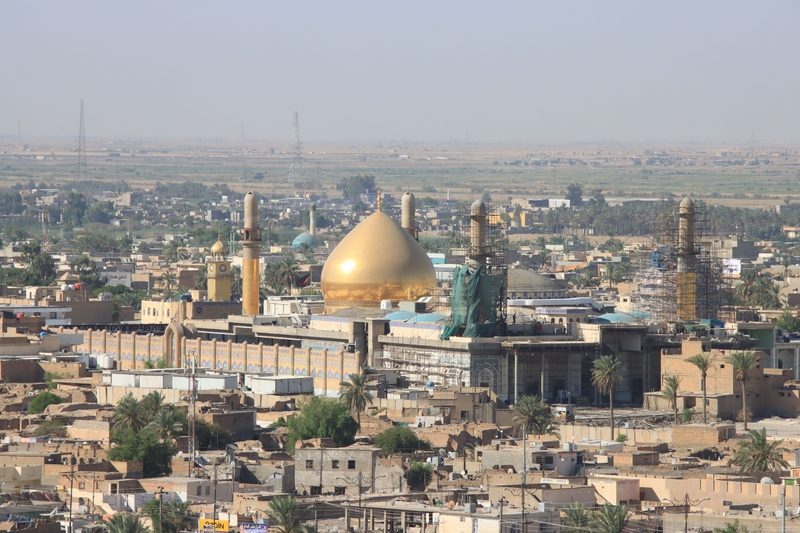
The Al-Askari Shrine — also known as the Golden Mosque — is one of the holiest sites in Shia Islam, surpassed in importance only by the shrines in Najaf and Karbala. It houses the tombs of the 10th and 11th Shia Imams, Ali al-Hadi and his son Hasan al-Askari, who lived under house arrest in Samarra during the Abbasid period and died here in the 9th century. Adjacent to the main shrine is the Serdab, the place where the 12th Imam — Muhammad al-Mahdi, the “Hidden Imam” — is believed to have entered occultation, a moment of profound significance for Shia Muslims worldwide.
The shrine’s famous golden dome, covered in 72,000 gold pieces and completed in 1905, was destroyed in a devastating bombing on 22 February 2006. The attack triggered a wave of sectarian violence across Iraq. The two golden minarets were destroyed in a second attack in June 2007. Both the dome and the minarets were rebuilt, and the shrine reopened to visitors in 2009. Today the reconstructed golden dome and blue-tiled walls gleam again above the Samarra skyline.
Non-Muslim visitors can enter the shrine compound. Modest dress is required, and you should behave respectfully — this is an active place of worship and deep pilgrimage, not a tourist attraction. Women must wear a headscarf and full-length covering. I always brief my guests before we visit, and the reception from shrine staff and pilgrims is consistently warm and welcoming, regardless of your faith.
Samarra Archaeological City (UNESCO)
In 836 CE, the Abbasid Caliph Al-Mu’tasim moved his capital from Baghdad to Samarra, and for the next 56 years it served as the seat of an empire that stretched from Tunisia to Central Asia. During this period, Samarra expanded into a massive city stretching over 40 kilometres along the Tigris, filled with palaces, mosques, military barracks, and gardens on a scale that rivalled anything in the medieval world.
When the capital moved back to Baghdad in 892, much of Samarra was abandoned — and that abandonment is precisely what makes it important today. Because the city was never continuously rebuilt the way Baghdad was, Samarra preserves the original plan and layout of an Abbasid capital like no other site on Earth. The Samarra Archaeological City was inscribed as a UNESCO World Heritage Site in 2007, covering over 15,000 hectares.
Beyond the Great Mosque and its minaret, the archaeological zone includes the ruins of enormous palace complexes and a second spiral minaret that most visitors never hear about — but that may actually be the bigger highlight.
Abu Dulaf Mosque and Its Spiral Minaret
About 15 kilometres north of the Malwiya, the Abu Dulaf Mosque has its own spiral minaret — smaller at 32 metres, but the same coiled design. The difference is that you can climb this one. The ramp winds up the outside with no outer handrail, just open air and a long drop to the desert floor. If you have any issue with heights, it is not casual. But if you are comfortable, the climb takes a few minutes and the views from the top are stunning — flat desert stretching to every horizon, with the larger Malwiya visible in the distance. This is one of the great experiences in Iraq, and one that most visitors miss entirely because they never make it past the more famous minaret.
The Abbasid Pool Palace
Near the Malwiya, on the route towards Abu Dulaf, sit the remains of Dar al-Khilafa, the Abbasid Pool Palace — a massive circular pool surrounded by the foundations of reception halls, partially reconstructed. Getting inside sometimes requires a bit of creative negotiation with the site guardians, but it is worth the effort. Stand in the centre of the empty pool, clap your hands, and the echo is extraordinary — a deep, reverberating sound that seems to come from everywhere at once, bouncing off the circular walls and amplified by the geometry of the ruins. It is surreal, almost alien, and one of those unexpected moments that you simply cannot get from a photograph. I make sure every guest experiences this.
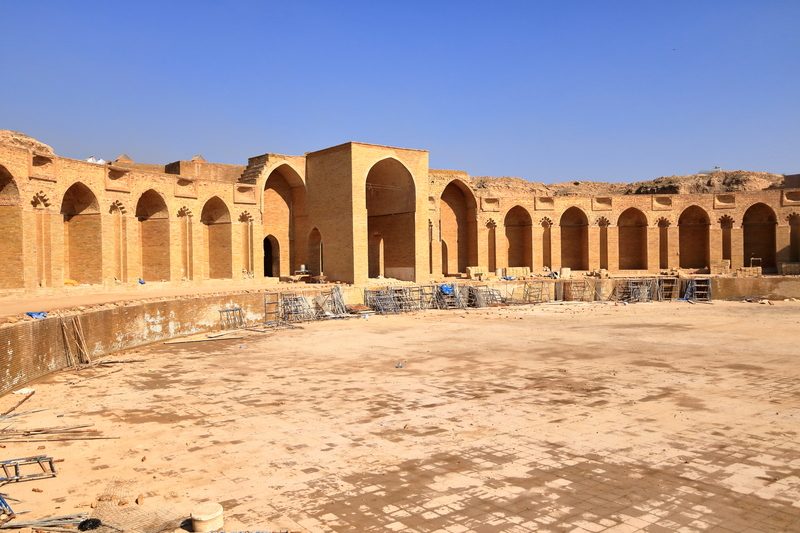
Most visitors to Samarra focus only on the Malwiya and the shrine, but the stretch between the two minarets — the Abu Dulaf climb, the Pool Palace echo, the palace ruins scattered across the desert — is where the site really opens up. And with 80 per cent of the archaeological city still unexcavated, Samarra will continue revealing itself for generations.
Practical Information
Getting There
Samarra is about 130 kilometres north of Baghdad, roughly a two-hour drive depending on checkpoint traffic. The road is good. Shared taxis run from Allawi garage in Baghdad. On my tours, I arrange private transport with a driver, which makes the journey simpler and more flexible.
Day Trip or Overnight?
Most visitors do Samarra as a day trip from Baghdad, and that works well. You can see the Malwiya, visit the Al-Askari Shrine, and explore some of the archaeological zone in a full day. There is no strong reason to stay overnight unless you want a slower pace. Samarra combines naturally with a Baghdad-based itinerary.
Security
Samarra has a complicated recent history. It was heavily affected by the insurgency and the fighting against ISIS, and parts of the city are controlled by militia groups rather than the central government. There are checkpoints entering the city and around key sites. The situation has improved significantly in recent years and tourists do visit regularly, but this is not a place to turn up without preparation. Travel with a guide or a tour operator who knows the current access situation. I check conditions before every visit and handle all checkpoint coordination for my guests.
What to Wear
For the Al-Askari Shrine, women must cover their hair and wear loose, full-length clothing — an abaya is provided at the entrance if needed. Men should wear long trousers and avoid shorts. At the Malwiya and the archaeological ruins, there is no dress code beyond common sense, but Samarra is a conservative city and modest clothing is respectful.
I include Samarra on the Complete Iraq Tour, and it can also be added as a day trip from Baghdad.
The Malwiya minaret is one of those places that stays with you — and climbing the Abu Dulaf spiral is something you will never forget.
Frequently Asked Questions
Can you climb a spiral minaret in Samarra?
The famous Malwiya minaret is currently closed to climbers. However, the Abu Dulaf Mosque about 15 kilometres north has its own spiral minaret — 32 metres tall — that you can climb. The ramp has no outer handrail, so it is not for anyone with a fear of heights, but the views from the top are spectacular.
Is Samarra safe to visit?
Samarra is visitable and tourists come regularly, but it requires planning. The city has checkpoints and a more complex security situation than Baghdad or Kurdistan. Travelling with a guide or tour operator who understands the current conditions is strongly recommended.
Can non-Muslims visit the Al-Askari Shrine?
Yes. Non-Muslim visitors are welcome in the shrine compound. Modest dress is required and respectful behaviour is expected. Women must wear a headscarf and loose full-length clothing.
How long does a visit to Samarra take?
A day trip from Baghdad is enough to see the Malwiya minaret, the Al-Askari Shrine, and some of the archaeological ruins. Allow at least five to six hours including travel time from Baghdad.