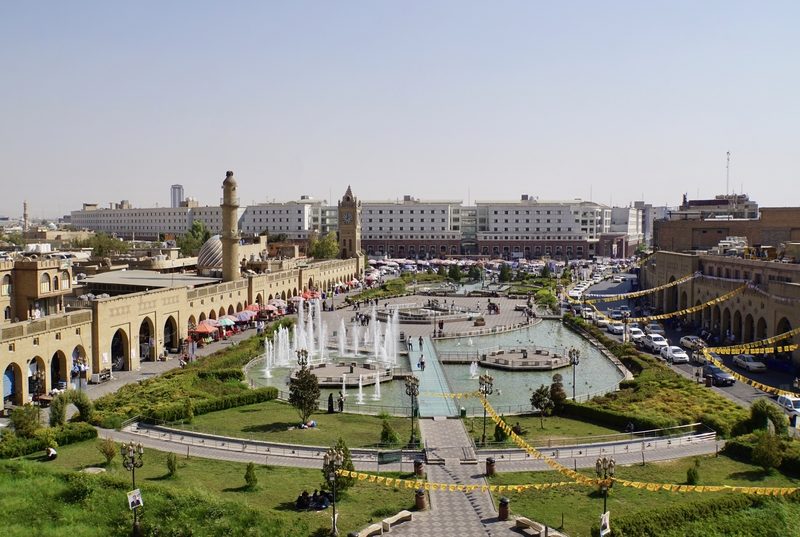
Baghdad and Erbil are Iraq’s two main cities, but they feel like different countries. Baghdad is ancient, sprawling, Arabic-speaking, and chaotic in the best way. Erbil is Kurdish, modern, relaxed, and built around a citadel that’s been continuously inhabited for over 6,000 years. Getting from one to the other — about 370 kilometres — is something almost every visitor to Iraq needs to figure out.

I make this Baghdad to Erbil trip regularly with guests, so I know the routes, the checkpoints, the flight schedules, and the stops worth making along the way. Here are your three options — with honest pros and cons for each. For broader trip planning, the Iraq travel guide covers everything else you’ll need.
Option 1 — Domestic Flight
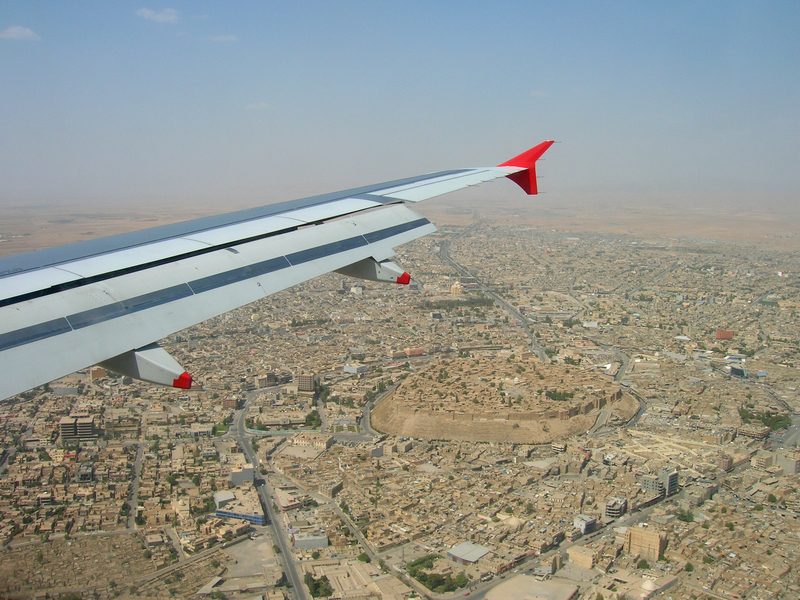
The fastest way from Baghdad to Erbil is to fly. Iraqi Airways operates the route with multiple daily departures, and the flight time is roughly one hour.
Tickets cost between $100 and $200 USD depending on how far in advance you book and the time of year. Book directly through the Iraqi Airways website or at the airport ticket offices — third-party booking sites sometimes show outdated schedules or inflated prices.
The pros are obvious: it’s fast, it’s cheap, and you skip every checkpoint. The downside is that you miss everything between the two cities — and there’s genuinely interesting stuff along that road. You also lose a bit of flexibility, since flight cancellations and delays do happen. If your schedule is tight and you just need to get from A to B, fly. If you have the time, the road is a better experience.
Option 2 — Drive (With a Guide)
This is how I take most of my guests, and it’s the option I recommend if your itinerary allows it. The drive from Baghdad to Erbil takes 5 to 6 hours via the main highway, depending on checkpoint traffic and whether we stop along the way.
You’ll pass through multiple checkpoints — this is federal Iraq, so military and police stops are part of the road. I handle all of them. I carry the paperwork, I know the soldiers on most of these routes, and the stops rarely take more than 2 to 3 minutes each. For my guests, it’s a non-event. For someone driving independently without Arabic, it would be significantly more stressful.
The road itself is flat and straight for the first few hours — classic Mesopotamian plain. As you approach Kirkuk and then Kurdistan, the landscape changes. You start seeing green hills, better road surfaces, and different signage (Kurdish alongside Arabic). The checkpoint where you cross from federal Iraq into the Kurdistan region is unmistakable — the atmosphere shifts noticeably. More relaxed, more modern, bilingual everything.
I include this drive as part of the Complete Iraq Tour, and it’s one of the parts guests remember most — not for the road itself, but for Samarra, the changing landscape, and the feeling of crossing from one Iraq into another.
Option 3 — Shared Taxi
Shared taxis run from Baghdad to Erbil daily, departing from the main garages (called “karaj” in Arabic). The cost is around $20 to $30 per person, which makes it the cheapest option by far.
The trade-offs are real, though. You’re sharing the car with strangers, the vehicles vary wildly in quality, departure times are whenever the car fills up rather than on a set schedule, and the driver will make multiple stops. The trip can take 7 to 8 hours or more. There’s no English spoken, and you’ll handle your own passport at every checkpoint.
For budget backpackers with flexible schedules and decent Arabic, shared taxis work. For most visitors I’d guide, it’s not the right fit. The comfort difference between a shared taxi and a private car with a guide who handles everything is enormous — and the cost difference, split across a day, is modest.
What to See Along the Way
The Baghdad to Erbil drive isn’t just a transfer — it passes through some genuinely interesting territory. Here’s what’s along the route.
Samarra (Stop Option)
About 125 kilometres north of Baghdad, Samarra is home to the Great Mosque and its famous spiral minaret — the Malwiya Tower. It’s a UNESCO World Heritage site and one of the most distinctive pieces of architecture in Iraq. The detour adds 1 to 2 hours to your journey, but it’s worth it if you haven’t seen it on a separate day trip from Baghdad.
Samarra is also a significant Shia pilgrimage city — the Al-Askari Shrine with its golden dome is here. Security is tight around the shrine area, but the city is safe and welcoming to tourists.

Kirkuk Area
You won’t spend time in Kirkuk city on this route — it’s more of a drive-through. But the area is historically significant as one of Iraq’s most ethnically diverse cities (Kurdish, Arab, Turkmen, Assyrian) and sits on top of some of the country’s largest oil fields. The citadel of Kirkuk is ancient, though not set up for tourism in the way Erbil’s is. If you’re interested in modern Iraqi complexity, the Kirkuk stretch of road tells a story just through what you see out the window.
Entering Kurdistan
The checkpoint where you cross from federal Iraq into the Kurdistan Region is a clear dividing line. On one side: Arabic signage, federal military. On the other: Kurdish and English signage, Peshmerga security forces, and a noticeably different feel. The roads improve, the towns look more developed, and the hills start rolling in.
For many of my guests, this crossing is one of the most memorable moments of the trip — not because it’s dramatic, but because it makes you realise just how much variety exists within a single country. By the time you reach Erbil, you feel like you’ve genuinely traveled, not just been transported.
Visa Considerations
This is important and catches people out. If you have a federal Iraq eVisa, you’re covered for the entire journey — Baghdad, everything in between, and Erbil. No issues at any checkpoint, no additional paperwork.
If you have a Kurdistan-only eVisa, you cannot start in Baghdad. That visa is only valid within the Kurdistan region. You’d need to fly into Erbil directly and stay within Kurdistan. Attempting to travel from Baghdad to Erbil on a Kurdistan visa will get you turned back at the first federal checkpoint.
This is one of the most common visa mistakes travelers make. The full breakdown — including the Kurdistan checkbox on the federal application — is in the Iraq visa guide.
Which Direction Should You Travel?
Most of my multi-day tours either start in Baghdad and end in Erbil, or the reverse. Both work well, but the direction depends on your itinerary and where you’re flying in and out.
Want to include the Baghdad–Erbil route in your trip?
I include this drive in the Complete Iraq Tour, with a Samarra stop and the option to add Mosul. Custom routes also available — tell me where you want to go and I’ll build it.
Baghdad → Erbil works best if you’re flying into Baghdad, want to see the central and southern sites first (Babylon, Karbala, the marshes), and then finish in Kurdistan before flying out of Erbil. This is the more common flow.
Erbil → Baghdad makes sense if you want to ease into Iraq through Kurdistan first — which is more relaxed and familiar — before heading into the intensity of federal Iraq. Some first-time visitors prefer this, especially if they’re nervous about the experience. A Kurdistan tour is a natural starting point.
Either way, I build the route around what makes sense for your dates, your flights, and what you want to see. If Mosul is on your list, the direction matters more — it sits between the two cities and fits naturally into the drive.